
- Article published at:
- Article author: satosachi
- Article comments count: 0
We visited Igawa Ayako's studio in Ibaraki Prefecture and had the opportunity to listen to her talk and see her painting. Igawa's studio, built in a corner of his spacious family home, is in a great location, providing an environment where he can calmly concentrate on his pottery making. The studio, which was built three years ago, is still new and very beautiful both inside and out.
-What made me want to become a ceramic artist?-
From a young age, Igawa loved drawing, making things, and using his hands. His grandfather painted Japanese-style paintings, and when he was in junior high school, the popular manga series Honey & Clover became popular, which inspired him to aspire to attend art school, so he enrolled in the Japanese-style painting course at Kyoto University of Art and Design. When it came time to think about finding a job, he began to wonder about his future and what kind of job would suit him as he searched for a job that would allow him to use his Japanese painting skills. Unable to find an answer, and with graduation approaching, the idea of pottery painting suddenly crossed my mind, and I thought that by combining my pottery techniques with those of Japanese painting, I might be able to make use of my own sensibilities.
- Embarking on a new path in pottery that he had never experienced before -
Since Kasama, a city famous for its pottery, is located in Ibaraki Prefecture, where he was born, he entered the Kasama Pottery Training Center after graduating from university. During his university days, he had the opportunity to listen to a ceramics professor speak as part of his classes, but it was only after he entered the ceramics training center that he actually got in touch with ceramics. When he first tried turning on a potter's wheel, it didn't go well at all and he thought it wasn't for him. Among his fellow students, some with experience using a potter's wheel were able to make nearly 100 pieces in a day, but Igawa struggled to get the shape right and was only able to make 15 , which made him feel that potter's wheel was not for him.
However, the casting technique he learned in the next curriculum (a method of creating a plaster mold and pouring in a slurry called slip, which is the raw material for pottery) suited Igawa's personality and felt right. "With a potter's wheel, you have to decide the shape of something that's constantly moving in an instant, and it's difficult to keep up with that speed. With casting, if you can make a mold accurately, you can create the product you want, so I thought I could do it too."
Igawa's current works include round plates and mugs made on a potter's wheel, and stylish plates and boxes made by casting. - What I felt when I came to the world of pottery - When he first entered the world of pottery, he found that it involved a lot more physical work than he had imagined, and he was worried about whether he could continue. However, Igawa says he is still able to continue creating pottery because it suits his personality. "In the world of painting, I didn't know where to place the brush. I would add a little bit, thinking maybe I should do this bit a little more...I didn't know when it would be finished, and it always made me anxious. If you want to add more, you can add as much as you want. But with pottery, you make it from clay, and once it's fired, there is a definite end - 'completion'. That gives me peace of mind. Only recently have I realised that it was a good fit for me."
- Until the start of the workshop -
After studying at a ceramics training center, she worked part-time under other ceramic artists while creating her works in rented kilns, and after getting married, she created her works in a room in her apartment. It was only after her child was born that she decided to set up a studio.
As the number of things he had increased and he could no longer secure enough space to work, he decided that "he needed a studio to do pottery seriously." With this in mind, he made up his mind and rented the land on his parents' property to set up a workshop.
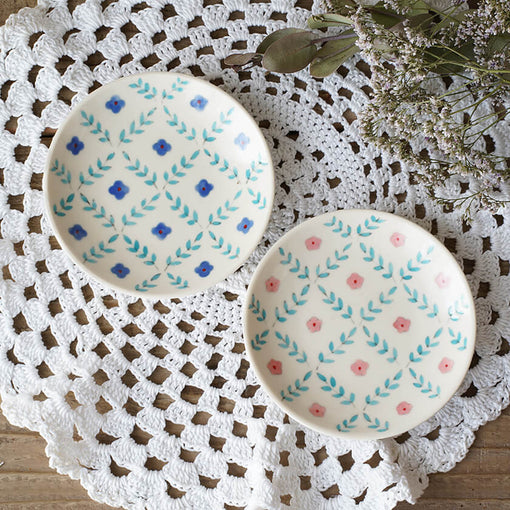
Originally, it was difficult to dispose of the wastewater and mud, so they had always felt that they needed a workshop to be able to create freely. When he was making his pottery in Kasama, there were many other artists around, so he would inevitably see their works and would often feel depressed by comparing them.However, after setting up his studio, he was able to work at his own pace, and he was able to feel more stable mentally and devote himself to pottery making. -About the style- Igawa's gorgeous works feature eye-catching designs of cute flowers and animals. Originally, he mainly painted flowers and plants, but after a gallery that had been helping him for a while suggested he try painting animals, he began painting more animals. "I like looking at Scandinavian goods and Indian textiles. When I look at illustrated guides for animals, I feel like they'll end up looking too realistic, so I use picture books as reference. I think I'll try drawing them in a simplified way like this. I often draw several patterns on drawing paper before deciding on an image. I just love drawing, so I enjoy thinking about what kind of design to make and painting the pottery." ◎Finally, we asked him what he keeps in mind when making pottery. It's about making it carefully. If I rush into making something, I often end up regretting it later and thinking I should have done it a certain way, so I try to stop and fix anything I notice while I'm there. If I think that a certain part of the picture didn't turn out well, I erase it without hesitation. If I let it go at that point, thinking it's okay, my eyes will still be drawn to that spot even after the piece is finished baking. I regret not having taken the time to fix it at the time, so even if other people don't notice, once I put it up for sale, I can't get it back, so I try to paint each picture carefully so that I don't have any regrets.
Learn More
